How to send Greek documents to clients who don't read Greek
In PropOS, you send the Greek document in your client's property file. They get a notification on their phone and read a short summary in the language they pick in their settings: English, Greek, French, Spanish, Hebrew, Arabic or Turkish. Need another language? We add it for you. The Greek original stays next to it, and your messages are translated too. PropOS is built for property management companies in Greece.
Published 1 November 2026 · Updated 1 November 2026 · PropOS team
No pitch deck. No commitment. Just an honest conversation.
Which Greek documents do clients abroad ask about?
The tax notice (εκκαθαριστικό εφορίας). The εκκαθαριστικό ΕΝΦΙΑ. The lease. The electricity bill. The building's common charges. The plumber's quote and, a week later, his invoice.
Every one of them arrives in Greek. For a client who does not read Greek, every one of them brings the same three questions: what is this, do I need to do anything, and how much is it?
So someone in your team scans the document, explains it, and answers the follow-up call. Next year the same document arrives again, and the explanation starts from zero, because last year's answer left with the colleague who gave it.
At thirty properties and a team of three, those questions add up. They land on whoever in your team picks up the phone that day, and the answer depends on who remembers the document.
How do you send a Greek document so your client can read it?
Open your client's property in PropOS and attach the document. Put it inside the conversation it belongs to (the repair, the lease renewal), or straight into the Vault.
PropOS files it on the property and writes a short summary in your client's language.
If you sent it in a conversation, your client gets a notification on their phone, with nothing to install. They open the property, read the summary and see the Greek original beside it.
If they have a question, they ask it in the same conversation, in their language. You read it in yours.
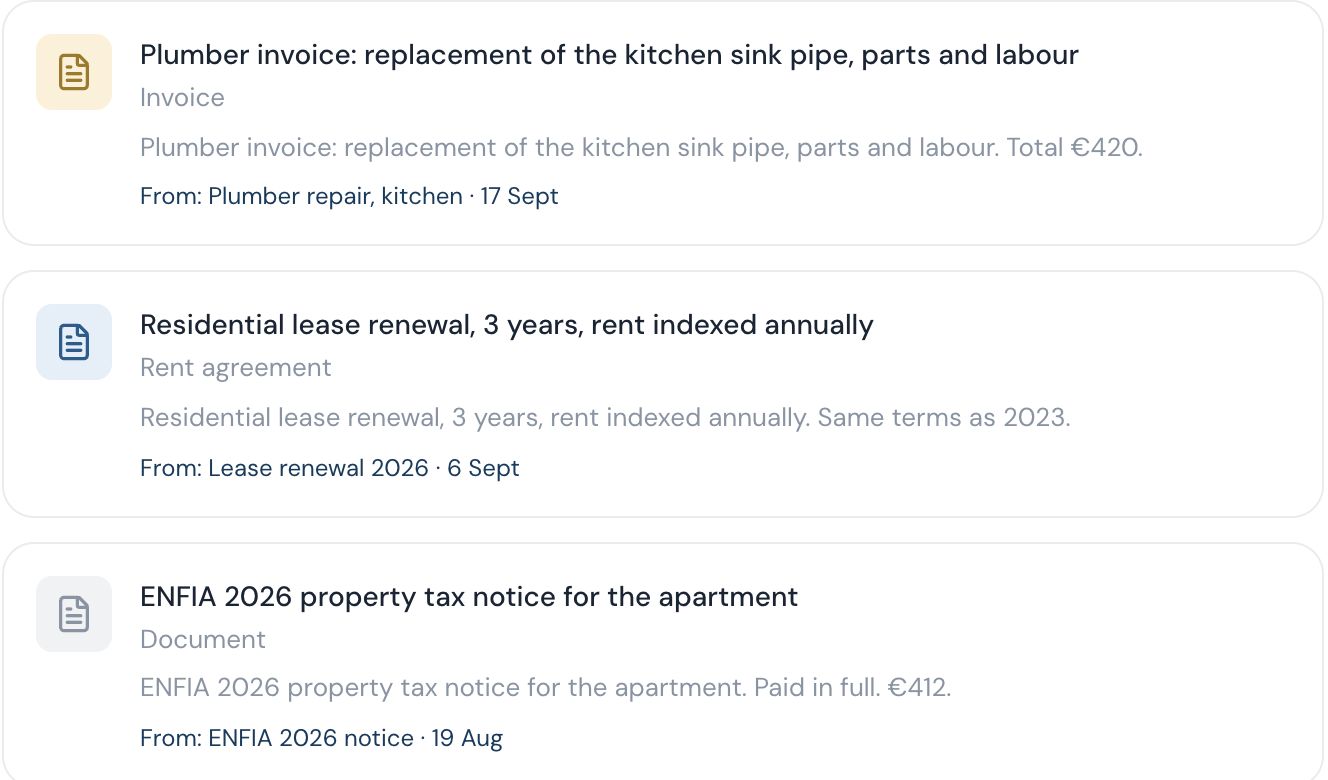
Here is what that looks like for two documents from a demo property:
| The Greek document you upload | What your client reads | |
|---|---|---|
Εκκαθαριστικό ΕΝΦΙΑ 2026 | ENFIA 2026 property tax notice for the apartment. Paid in full. €412. | |
Τιμολόγιο υδραυλικού | Plumber invoice: replacement of the kitchen sink pipe, parts and labour. Total €420. |
No pitch deck. No commitment. Just an honest conversation.
Is a summary the same as a translation?
No, and it is not meant to be. The summary tells your client what the document is and its key details, such as the amount. It answers the first question every client has: what is this, and how much?
It is not an official or certified translation. When a client needs one, that is a job for a certified translator. For everything else, the original is always there and opens with one tap.
Are your messages translated too?
Yes. You write in Greek. Each client reads your message in the language they chose. They reply in theirs, and you read the reply in yours.
So one person in your team can answer a client who reads English, one who reads French and one who reads Hebrew on the same morning, without writing a word in French or Hebrew. A new hire can do the same from their first day.
Which language does each client read in?
The one each client picks from seven: English, Greek, French, Spanish, Hebrew, Arabic or Turkish. Need another language? We add it for you.
So a client who reads Hebrew reads every document summary and every message in Hebrew. A client in Greece can stay in Greek. Your team writes in Greek for all of them, and nobody has to remember who reads what.
If most of your clients read English, start there. When a client who reads French or Arabic joins, nothing changes for your team.
Where does the document stay afterwards?
In the Vault of that property. If you sent it in a conversation, it stays linked to it, and one tap takes you back to that conversation: why the document was sent, what your client asked, what you answered.
When a colleague takes over the property, the documents and their history are already there.
Your client sees only their own properties, under your company's name and logo.
Everything you want to know.
Anything else, ask on the call.
Can clients abroad read a Greek tax notice in English?
Yes, as a short summary in English, or in French, Spanish, Hebrew, Arabic, Turkish or Greek, with the Greek original next to it. You upload the document to the property in PropOS, and your client reads it on their phone. Need another language? We add it for you.
Is a shared folder enough for Greek documents?
For storing files, it can be. What a folder does not keep is the history behind each document: why it was sent, what the client asked about it, what was agreed. In PropOS the document stays attached to its conversation, with a summary in your client's language.
Can my client still see the Greek original?
Yes. In PropOS the original always stays next to the summary, on the property. Your client can open it at any time.
See it from both sides: your desk, and your client's phone.
No pitch deck. No commitment. Just an honest conversation.